Somerset & Burnside, Kentucky
Drain Field Repair in Somerset & Burnside, Kentucky
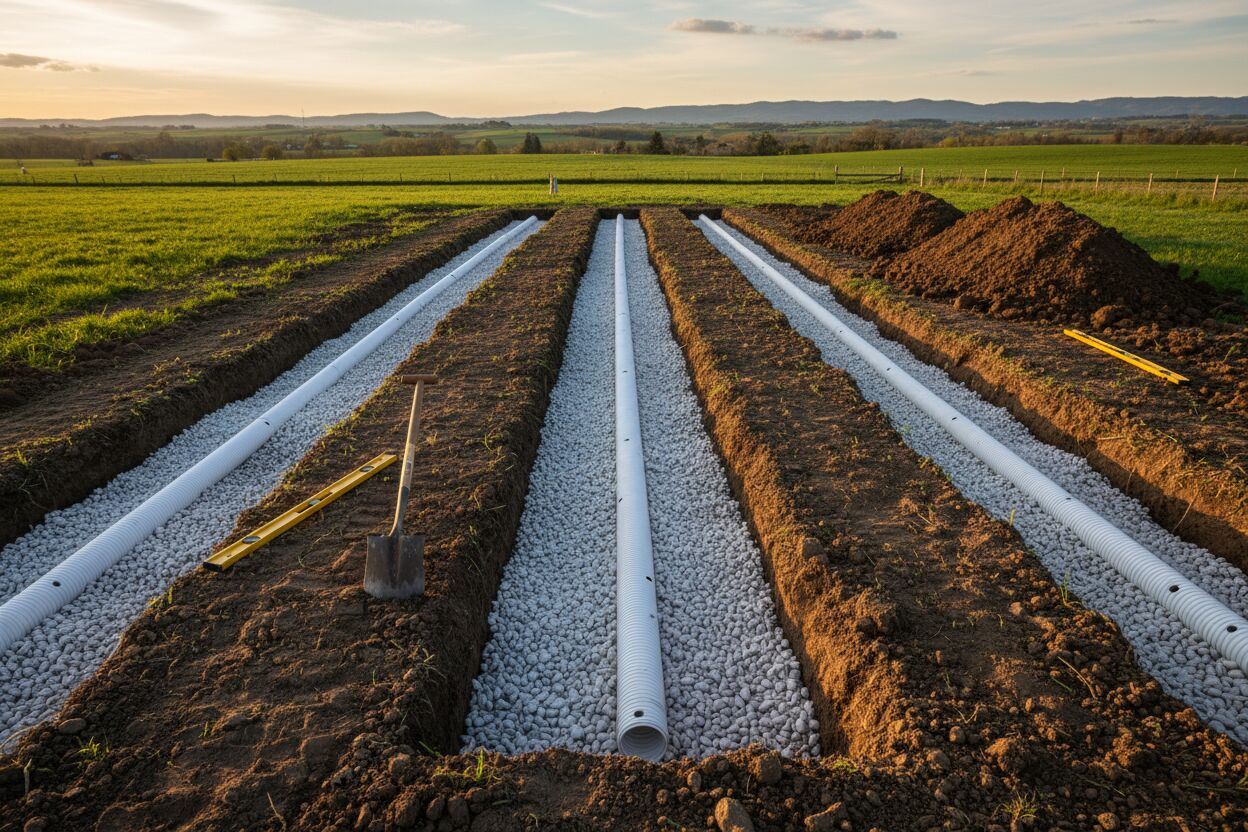
When a drain field stops absorbing water, pumping the tank won't fix it — the ground itself has quit doing its job. We diagnose and repair failing drain fields across Somerset, Burnside, and rural Pulaski County, with siting decisions that respect the karst limestone running under much of the county.
- Field diagnosis before any dig starts
- Repairs for clogged lines and distribution boxes
- Full rebuilds sited around karst and thin soils
- Work coordinated with the required health department steps
Get a Free Quote
Tell us what's going on — we'll call you back fast.
Field Lifespan
How Long a Drain Field Lasts in Pulaski County
A well-maintained conventional drain field generally holds up for 15 to 25 years. Chamber-based systems installed in good soil can push past that, sometimes reaching 30 years, and some broader industry estimates put a properly cared-for field's life as high as 50 years under ideal conditions. Where your field falls in that range comes down to soil type, how much water the household sends through it, and whether the tank upstream has been pumped on schedule.
Karst Ground
Why Failing Fields Carry Extra Risk on Karst Ground
Pulaski County's western two-thirds sits over karst limestone — a network of caves, sinkholes, and underground channels documented across the county, including a mapped "karst window" at Short Creek where a stream surfaces from underground. The Kentucky Geological Survey is explicit on this point: septic systems here should never discharge into a sinkhole or crevice, because karst conduits move water so fast that waste can reach the water table with almost no filtering. A drain field that's already struggling on karst ground isn't just a slow-drain inconvenience — it's a shortcut for contamination if it's left alone. That's why we treat a failing field as a siting problem first, not just a repair job.
Warning Signs
Signs Your Drain Field Has Stopped Working
- Sewage odor hanging over the field, especially after rain
- Soggy or spongy ground that stays wet even in dry weather
- A patch of grass over the field that's noticeably greener or growing faster than the rest of the yard
- Multiple drains in the house backing up together instead of one at a time
- Standing water pooling near the field lines
Where We Work
Drain Field Repair & Replacement in Somerset & Burnside
We handle drain field repair in Somerset and the county around it, plus drain field repair in Burnside and the lake-adjacent communities nearby, where seasonal cabins can push an aging field past its limit faster than a year-round home would.
Related Work
Field Trouble Traced Back to the Tank
A struggling field often starts with a tank that's overdue — see septic tank pumping to get ahead of it. If the fix turns out to be a full system rebuild rather than a field repair, our septic system installation page covers the permit process that comes with it.
Questions
Drain Field Questions from Pulaski County Homeowners
How long does a septic drain field last?
A properly maintained conventional drain field typically lasts 15 to 25 years. Chamber-based systems in good soil can reach 30 years, and broader estimates for well-maintained fields run as high as 50 years depending on soil, usage, and upkeep.
Why is drain field siting especially tricky in Pulaski County?
Roughly two-thirds of the county, mostly to the west, lies over karst limestone laced with caves, sinkholes, and solution channels. The Kentucky Geological Survey warns that a drain field discharging into a sinkhole or crevice can send waste into groundwater with almost no natural filtering, so siting has to account for what is under the lot, not just what is on top of it.
What are the signs a drain field is failing?
Sewage odor over the field, soggy or spongy ground even in dry weather, patches of unusually green or fast-growing grass, and drains that back up together instead of one at a time all point to a field that has stopped absorbing water properly.
Can a failing drain field be repaired, or does it need full replacement?
It depends on the cause. A clogged distribution box or a broken line can often be repaired on its own. Soil that has become saturated or compacted across the whole field usually means the field needs to be rebuilt or relocated.
Septic Backing Up? Tank Overdue for Pumping?
Same-day septic service across Somerset, Burnside & rural Pulaski County.